
What I Learned From Ten Years of High Point Market — the Patterns That Repeat

Ten years of High Point Market teaches you something that no single market can. Trends feel new the first time you see them. The second time, they feel familiar. The third time, you realize you're watching a cycle that's been turning for decades. Materials, silhouettes, and colors don't disappear—they rotate. They go quiet for a few years, then reappear in a slightly updated form, presented as something fresh. Here are the patterns I've tracked, where we are now, and what I expect to see next.
The Three Cycles That Repeat
Every five to seven years, the industry revisits three things: a material, a silhouette, and a color. The cycle isn't perfectly regular—economic downturns stretch it, social media compresses it—but it's consistent enough to bet on. If you understand the cycle, you can buy furniture ahead of the curve or, more importantly, avoid buying at the peak of a trend that's about to feel tired.
The Material Cycle: Oak Is Back (Again)
Right now, we're in an oak moment. White oak, specifically—lightly wire-brushed to bring out the grain, finished in a warm beige or a pale ceruse. It's on dining tables, bed frames, case goods, even kitchen cabinets. Five years ago, it was walnut. Before that, it was dark espresso-stained oak, the ubiquitous finish of the mid-2000s. Before that, it was natural maple in the '90s.
Oak cycles back roughly every seven years because it hits a sweet spot: it's durable, domestically sourced in North America, takes stain evenly, and has a prominent grain that reads as "crafted" without being rustic. Walnut cycles in for a darker, more formal look. Maple and cherry occupy the lighter, cleaner moments in between. Right now, oak is at its peak—every brand has a white oak collection, and the market is saturated. If you love oak, buy it now and enjoy it, but know that in three to four years, the industry will start pivoting back toward darker woods. Walnut will return. It always does.
The Silhouette Cycle: Curves Are Peaking
I covered the current curve trend in my last two posts, but the cycle is worth naming directly. Furniture silhouettes swing between angular and organic roughly every five to seven years. The mid-2010s were all straight lines: squared-off arms, rectangular case pieces, clean mid-century legs. Now we're in the organic phase: curved sofas, round dining tables, barrel-back chairs, fluted details that soften hard edges.
The pendulum will swing back. The question is when, not if. Signs to watch: when curved pieces start appearing in budget-focused mass retail catalogs, the trend is at saturation. When designers at ICFF start showing sharper, more architectural forms, the industry is already pivoting. I'd give the current organic cycle another two to three years before angular starts looking fresh again. If you're investing in a major piece like a sofa, ask yourself whether a curve will still feel right to you in five years. If the answer is yes, buy it. If the answer is maybe, buy a straight sofa and get your curves from an accent chair you can swap out.
The Color Cycle: Green Is the New Blue
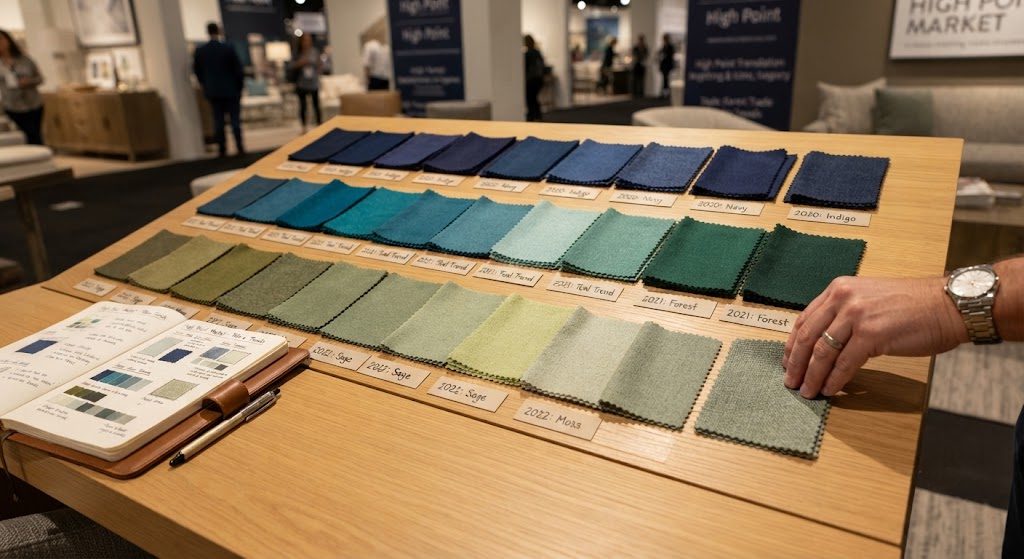
Ten years ago, the dominant upholstery color was charcoal gray. Then navy blue took over for a solid four-year run—every sofa, every accent chair, every headboard. Then came the jewel tones: emerald, sapphire, amethyst, a brief and intense moment around 2018–2020. Now we're in green's era: olive, sage, moss, and deep forest. Green has been building for three years, and it's currently at the peak of its cycle—widely available at every price point, from high-end velvet sectionals to budget-friendly accent chairs.
What comes after green? Based on the pattern, warm earth tones are already gathering. Terracotta, rust, clay, and burnt sienna are appearing in accessory lines and accent pieces, which is always the leading indicator. In two years, I expect those warm tones to hit upholstery in a significant way. If you're repainting a room or buying a sofa, consider whether green will feel like a choice or a time stamp in five years. Green is beautiful, and it's been my personal favorite for years, but it's also nearing the saturation point where it will soon read as "early 2020s" the way navy reads as "late 2010s."
How to Use This Pattern
The cycle doesn't mean you should chase trends. It means you should recognize when you're about to buy at the peak of one. If you love a material or a color that's currently everywhere, buy it in pieces you can replace affordably—throw pillows, an accent chair, a lamp. Keep your big investments in silhouettes and finishes that have already cycled through and will cycle back. Straight sofas, solid wood dining tables, and neutral case pieces in walnut or oak never look dated for long. They just wait their turn.
Keep Reading
Furniture Outlet Shopping: How to Find Quality Pieces at a Real Value
Furniture outlet shopping guide: learn how to judge frames, upholstery, delivery...
Grey Accent Chair Ideas: How to Choose One That Looks Expensive
Grey accent chair ideas for a polished, livable room. Learn which fabrics, frame...

Panel Bed Buying Guide: What Actually Matters Before You Buy
Panel bed buying guide: learn how to compare wood, upholstery, joinery, storage,...
Owner Letters
0 lettersNo letters yet — be the first to write one.