
What I Saw at High Point That Actually Matters — and What'll Be Forgotten by Next Spring

I've walked the High Point Market floor for over a decade, and the pattern never changes: every April and October, the industry rolls out what it believes will define the next two years of American living rooms. Some of it sticks. Most of it doesn't. My job as a buyer was never to chase what's new—it was to identify what's durable enough to put on a purchase order and bet the company's inventory dollars on. Here's what I saw this market that clears that bar, and what won't survive the winter.
Two Trends With Legs
Not everything at market is a trend. Some of it is a genuine shift in how furniture is designed, manufactured, and sold. These two developments qualify.
The Deep-Seat Modular Sectional Is Now the Default
If there was one silhouette that dominated every showroom—from mid-tier domestic manufacturers to the European imports at the high end—it was the deep-seat modular sectional. Seat depths of 24 to 26 inches, down from the 22-inch standard of five years ago. Low, wide armrests built for perching a laptop or a drink. And modularity that's no longer a selling point but an expectation: every piece can be rearranged into an L-shape, a U-shape, or a pair of facing chaises.
What makes this trend durable isn't the look. It's the function. A 25-inch seat depth accommodates the way people actually sit—legs tucked up, laptop on lap, dog wedged in the corner—in a way that a formal 22-inch sofa never could. The modularity means the same sectional can follow a family from an apartment to a house, from one room shape to another. This isn't a silhouette chasing a fad. It's the industry finally designing for how people live. I'd bet inventory on it.
Performance Fabric Is Eating the Upholstery Market
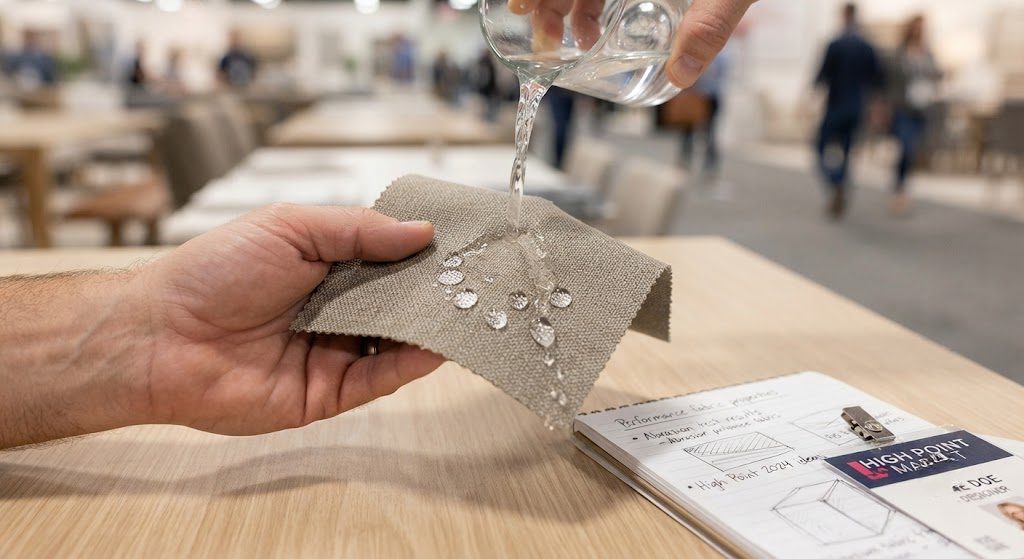
Performance fabric used to mean a rough, outdoor-only textile in beige or gray. This market, I counted seventeen showrooms offering performance-grade upholstery with the hand feel of linen, velvet, or cotton twill. Solution-dyed acrylics, polyester blends with stain-resistant treatments, and indoor-outdoor bouclés that you'd never guess were synthetic. Rub counts are hitting 100,000 and above—commercial-grade durability on residential furniture.
One mill in North Carolina showed me a performance velvet with a 120,000 double-rub rating that felt indistinguishable from cotton velvet. At $45 a yard wholesale, it's still a premium, but it's no longer a trade-only product. Within two years, I expect performance fabric to be the default option on mid-tier sofas, the way stain-resistant carpet became the default in the '90s. Buy it now and you're ahead of the curve. Wait two years and you'll be choosing from the same fabrics as everyone else.
Three Trends That Are Already Tired
Bouclé in high-traffic applications. I saw it on dining chairs, on barstools, on headboards. Bouclé is a looped yarn fabric that pills under friction, snags on belt buckles, and stains when you look at it wrong. On an accent chair in a formal living room, it's beautiful. On a kitchen counter stool, it's a warranty claim waiting to happen. This market pushed bouclé into surfaces that see daily use, and that's a mistake the returns desk will handle by spring.
Fluted everything. Fluted legs on dining tables, fluted fronts on credenzas, fluted glass on pendants. It's the design equivalent of a hit single that gets played until everyone hates it. One or two fluted pieces in a room adds texture. A whole room of fluting looks like a showroom that couldn't make a second decision. This one burns bright and fades fast.
The Instagram beige room. Warm neutrals, tonal layering, travertine accents, everything the color of a latte. It photographs beautifully and lives terribly. Real homes have coffee stains, dog paws, and blue jeans that transfer dye onto light upholstery. The monochrome beige room looks sophisticated in a catalog and exhausted in real life after three months. The pendulum is already swinging toward color—I saw more saturated greens and deep blues at this market than I've seen in five years combined.
One Material Innovation Worth Watching
The most interesting thing I saw wasn't a piece of furniture. It was a material. A manufacturer in the outdoor section showed me a recycled polyethylene weave that looked and felt like natural wicker but was rated for full sun exposure, saltwater air, and freeze-thaw cycles without cracking. It's made from post-consumer plastic and can be recycled again at end of life. The wholesale price is currently 40% higher than traditional resin wicker, but the durability numbers are double. For anyone furnishing a coastal property or an exposed patio, this material solves the tradeoff between natural look and weather resistance. I'm watching this one closely. If the price comes down 20%, it becomes the outdoor furniture story of the decade.
Keep Reading

Furniture Outlet Shopping: How to Find Quality Pieces at a Real Value
Furniture outlet shopping guide: learn how to judge frames, upholstery, delivery...

Grey Accent Chair Ideas: How to Choose One That Looks Expensive
Grey accent chair ideas for a polished, livable room. Learn which fabrics, frame...

Panel Bed Buying Guide: What Actually Matters Before You Buy
Panel bed buying guide: learn how to compare wood, upholstery, joinery, storage,...
Owner Letters
0 lettersNo letters yet — be the first to write one.