
When a Trend Hits Wayfair, You're Two Years Late: Notes From the Floor
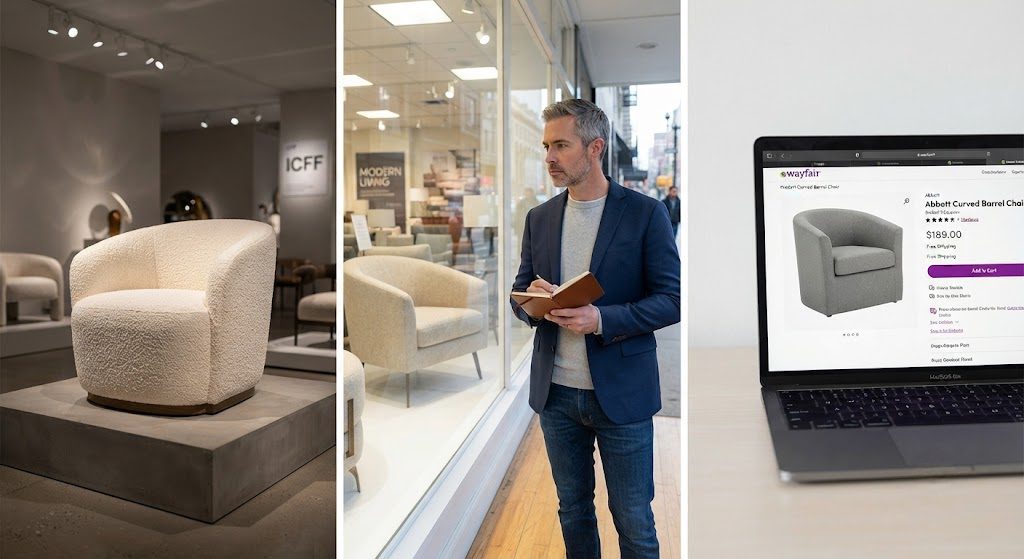
Every furniture trend follows the same path. It starts in a design studio or a European trade show, gets picked up by high-end manufacturers, trickles down to mid-market brands, and eventually lands on mass retail sites where it's sold for a fraction of the original price. By the time a trend reaches the point where you can order it with free two-day shipping, the people who set the trend have already moved on. Here's how to read the chain, and how to use it to make smarter buying decisions.
The Trend Chain: Four Stages
I've watched this cycle repeat for fifteen years across every major furniture category. The timeline varies—some trends take five years to reach mass retail, others make the journey in eighteen months—but the sequence never changes. Understanding where a piece sits on this chain tells you whether you're buying something fresh or something that's already aging.
Stage One: Milan and ICFF
Every furniture trend worth tracking starts here. Salone del Mobile in Milan each April and ICFF in New York each May are where designers and manufacturers show work that won't reach a retail floor for twelve to eighteen months. These shows aren't selling product—they're selling ideas. Materials, proportions, color directions. The furniture on display is often one-off, prototype, or produced in runs of fifty pieces for galleries and high-end design shops.
When I walk these shows, I'm not looking for pieces to buy. I'm tracking directions. Three years ago at Salone, I noticed five independent designers showing seating with inflated, pillowy proportions—what the industry now calls the "puffy" or "cloud" silhouette. Last year, that silhouette was in every mid-tier showroom at High Point. This year, it's on Wayfair for $399. The people who bought it from the original designers paid $6,000 and got a piece of design history. The people buying it on Wayfair are getting a derivative that photographs similarly but uses 1.5 PCF foam and a pine frame. Both have their place. But you should know which one you're buying.
Stage Two: High-End Showrooms
Twelve to eighteen months after Milan, the trend lands in showrooms like those at High Point Market—manufacturers who serve interior designers, boutique hotels, and high-end residential clients. The pieces are production-ready but limited in distribution. Materials are authentic: solid hardwood frames, high-resilience foam, performance fabrics with commercial-grade rub counts. Prices are full retail, and the designs are close to the original intent.
This is the window where the trend is at its best—the design language is still coherent, the manufacturing quality hasn't been compromised, and the pieces haven't been simplified for mass production. If you want to participate in a trend without buying disposable furniture, this is the stage to shop. The curved sofas I wrote about in the previous post are in this window right now.
Stage Three: Mid-Market Catalogs
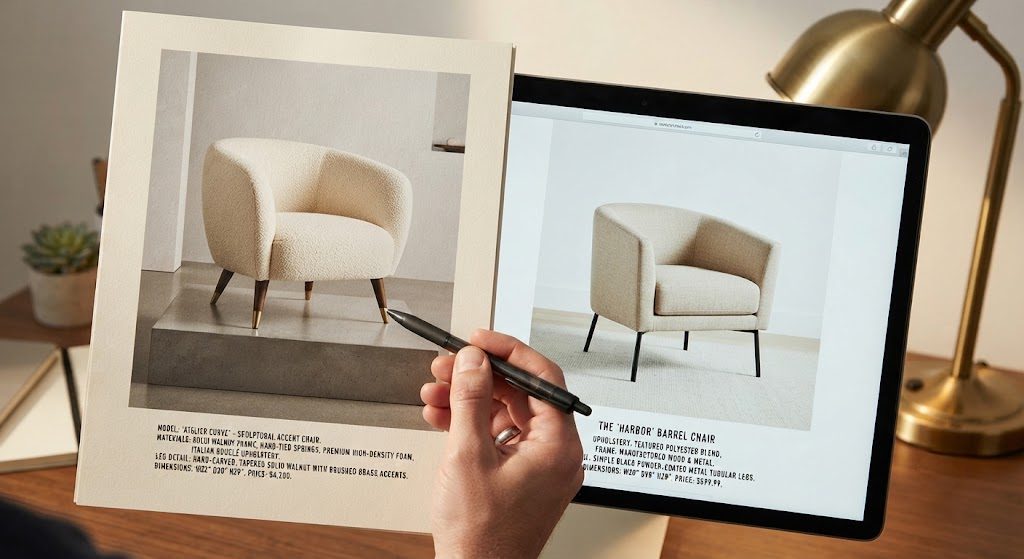
Another twelve to eighteen months, and the trend reaches mid-market brands—the Crate & Barrels, the West Elms, the direct-to-consumer companies that scale designs for national distribution. The silhouette is recognizable but simplified. The curved sofa that required a complex frame at Stage Two becomes a gentler curve that can be produced with standard joinery. The barrel-back chair gets a slightly wider seat and a slightly lower back to accommodate a broader range of body types. Materials shift: solid wood becomes veneer over engineered wood, performance velvet becomes a poly-blend with a 30,000 double-rub rating instead of 100,000.
This stage is the value sweet spot. The design language is still intact, the quality is still reasonable for daily use, and the price has dropped by 50 to 70 percent from Stage Two. Most people furnishing a real home on a real budget should shop here—after the trend has matured enough to be accessible but before it's been stripped down to its cheapest possible version.
Stage Four: Mass Retail
When a trend reaches Wayfair, Amazon, and big-box retailers, it's been two to three years since Milan. The silhouette is a photocopy of a photocopy. The curved sofa is now a standard straight frame with curved arm caps. The barrel-back chair is a molded plastic shell with a foam wrap and a fabric cover stapled underneath. The fluted legs are printed veneer over particleboard.
This isn't inherently bad. If you need a chair for a rental or a guest room you furnish once and use twice a year, mass retail serves that purpose. But don't mistake it for the trend. You're not buying the design—you're buying an echo of it. And by the time it reaches this stage, the design world has already moved on to the next silhouette.
What This Means for Your Living Room
If you want your home to feel current, shop Stage Two or early Stage Three. If you want value without looking dated, shop mid-to-late Stage Three and avoid anything that's clearly a watered-down version of a trend you've already seen everywhere. If you're furnishing a temporary space, Stage Four exists for exactly that reason.
The chain isn't a secret. It's just not explained to anyone outside the industry. Now that you know it, you can place every piece of furniture you see on its timeline—and decide whether you're buying the trend, or just its shadow.
Keep Reading

Furniture Outlet Shopping: How to Find Quality Pieces at a Real Value
Furniture outlet shopping guide: learn how to judge frames, upholstery, delivery...

Grey Accent Chair Ideas: How to Choose One That Looks Expensive
Grey accent chair ideas for a polished, livable room. Learn which fabrics, frame...

Panel Bed Buying Guide: What Actually Matters Before You Buy
Panel bed buying guide: learn how to compare wood, upholstery, joinery, storage,...
Owner Letters
0 lettersNo letters yet — be the first to write one.