
How to Read a Furniture Sale: The Buyer's Guide to Not Getting Played

Furniture sales have a language, and it's designed to make you feel like you're getting a deal whether you are or not. I've sat on the other side of this—managing inventory, marking down discontinued lines, and deciding which pieces went to the outlet floor. The difference between a genuine discount and a manufactured one isn't always obvious from the price tag. Here's how to decode the language, read the situation, and walk out knowing you paid a fair price.
The Four Types of Furniture Sales
Not all markdowns are created equal. Each type of sale has a different motivation behind it, and understanding that motivation tells you how good the deal actually is—and how hard you can negotiate.
Floor Sample: The Best Deal You'll Find
Floor samples are the furniture equivalent of a car with 5,000 miles on it. The piece has been sat on, opened, touched, and tested by hundreds of shoppers. It may have minor wear—a scuff on a leg, a cushion that's been flipped a few dozen times, a slight fade from showroom lighting. But it's also fully assembled, inspected, and available for immediate pickup or delivery without the eight-to-twelve-week lead time that custom orders require.
Floor sample discounts typically run 20 to 40 percent off retail, sometimes deeper if the piece is being discontinued and the floor model is the last one. The key advantage is that you're buying a piece you can inspect in person, right now. You know exactly what you're getting. You can check the joinery, test the cushions, and look for any damage before you pay. You can also negotiate—floor samples are taking up space the retailer needs for new inventory, and the longer a sample sits, the more motivated the store manager becomes. Ask for an additional 10 to 15 percent off if the piece has visible wear. Ask for free delivery. Ask for a discount on the protection plan. The worst they can say is no.
Discontinued: A Good Deal With a Catch
When a manufacturer discontinues a line, the retailer needs to clear the remaining inventory to make room for new product. These discounts are real—typically 25 to 50 percent off—because the store can't reorder the piece and doesn't want it taking up warehouse space. The catch is parts and service. If a discontinued dining chair breaks a leg two years later, the manufacturer may not have replacements available. If you want to add a matching piece later, you probably can't. Buy discontinued pieces that don't need to match anything else—an accent chair, a side table, a floor lamp—and avoid buying a discontinued sofa if you're likely to want the matching loveseat or ottoman down the line.
Overstock: Genuine Value, Limited Selection
Overstock sales happen when a retailer orders more inventory than they sold. The merchandise is current, not discontinued, and it's typically discounted 15 to 30 percent. The discount is modest because the piece is still in production and the retailer could theoretically sell it at full price. Overstock is a good opportunity to buy a piece you were already planning to purchase—not a reason to buy something you don't need just because it's marked down. The selection is usually limited to specific colors, sizes, or configurations. If the overstock piece matches what you wanted anyway, take the discount and be happy.
Real Markdown vs. Manufactured Urgency
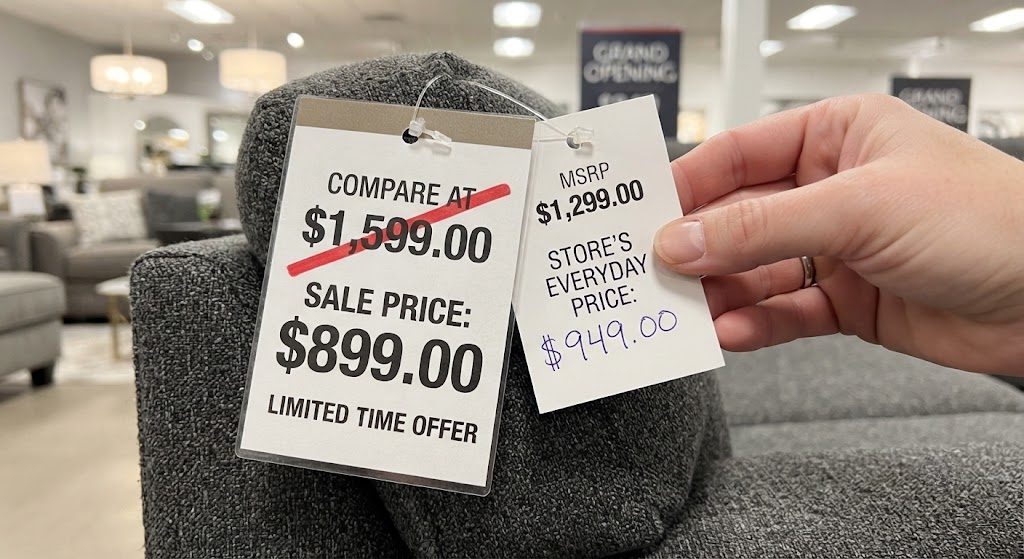
This is where you need to pay attention. A "compare at" price on a tag is not the same as the manufacturer's suggested retail price. The "compare at" number is often set by the retailer and can be inflated to make the discount look deeper. I've seen tags where the "compare at" price was double what the same retailer charged for the piece three months earlier. The sale price—the actual price you'd pay—hadn't changed. Only the reference number had moved.
The best defense is to research the piece before you buy it. Check the manufacturer's website for the MSRP. Check other retailers to see what they're charging for the same piece. If the sale price is 15 to 40 percent below the real market price, it's a genuine deal. If the discount is calculated off a "compare at" number that seems suspiciously high, it's a marketing tactic, not a markdown.
How to Know If a Sale Is Real
Track the piece. Write down the model number, the price, and the date. Check back in two weeks. If the price is still the same but the "sale" signage has changed to a "new low price" event, the discount was never real—it's the everyday price dressed up in a red tag. Real sales are time-limited. The price goes up when the sale ends, or the inventory sells out. If a piece is on perpetual sale, the sale price is just the price.
Ask one question: "Is this the lowest price you'll offer this season, or are there upcoming promotions I should know about?" Sales associates often know the promotion calendar and will tell you—or their hesitation will tell you more than their words. I've used this question for years, and it has never failed to surface useful information. A good salesperson wants you to buy now, but they also want you to come back. Giving you honest information about timing serves both goals.
Don't fall for the "only one left" routine unless the piece is actually a floor sample or a discontinued line. Current inventory is replenishable. Scarcity on current product is artificial. Walk away, think about it overnight, and come back if you want it. The furniture will still be there. If it's not, it wasn't the only one—it was the only one they wanted you to believe was left.
Keep Reading

How to Find Furniture Discount Stores Near Me Without Buying Junk
Find furniture discount stores near me without sacrificing quality. Learn how to...

Luxury Furniture That Earns Its Price: A Buyer’s Guide
Luxury furniture advice from a former senior buyer: learn how to judge frames, j...

How to Choose a Dining Set for 6 That Actually Works
Find a dining set for 6 that fits your room, budget, and daily life. Learn which...
Owner Letters
0 lettersNo letters yet — be the first to write one.