
I Spent 45 Minutes in This Sectional at Three Different Stores. Here's What Nobody Tells You.
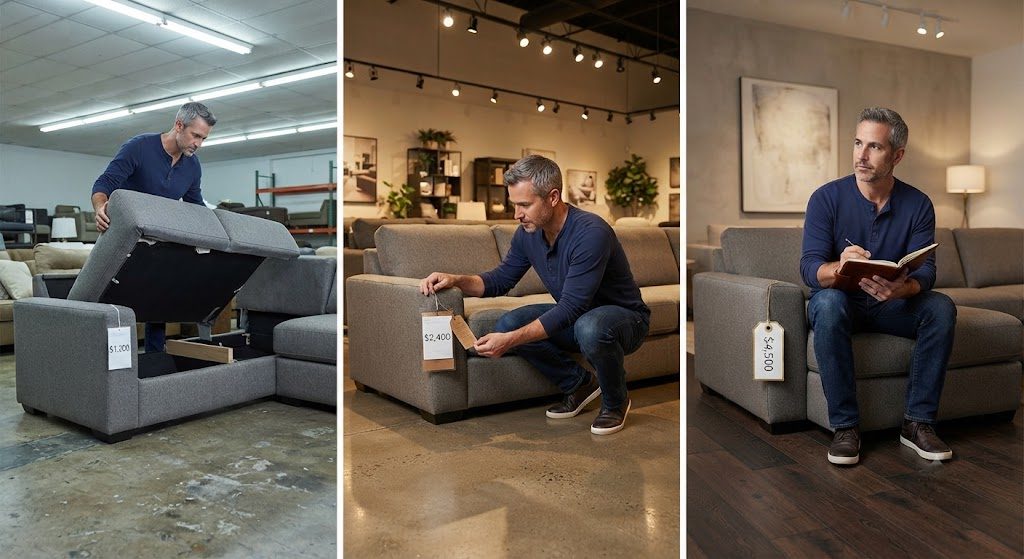
The sectional had the same silhouette every time: a left-arm-facing chaise, three-seat sofa, low profile, performance fabric in oatmeal. At a glance, they could have been triplets. But underneath, they were built like completely different pieces of furniture. After 45 minutes in each store, lifting cushions, unzipping cases, measuring foam, and flipping frames, here's what $3,300 extra actually buys you—and what it doesn't.
The Three Versions
I tested the same L-shape at three retailers chosen to represent distinct price tiers: a national big-box chain, a mid-tier specialty furniture store, and a high-end design showroom. All three carried a modular sectional with a near-identical footprint. None of the salespeople knew who I was.
The $1,200 Version: Where the Math Fails
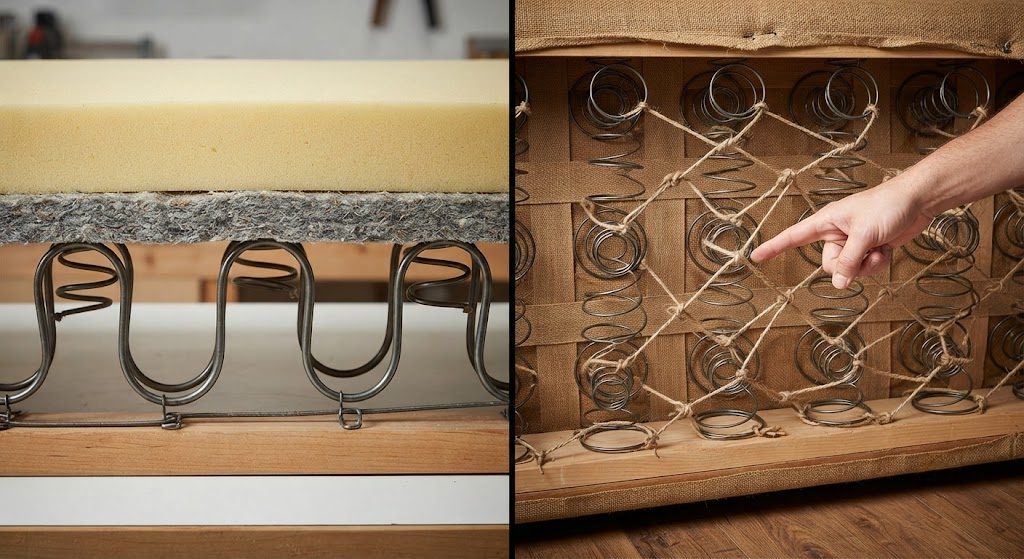
The frame was a mix of pine and particleboard, joined with staples and a single corner block that was only glued—no screws. The foam measured 1.5 PCF. Under the cushions, the deck was a thin sheet of non-woven fabric stretched over sinuous springs with no insulator pad. When I sat hard, I felt the spring grid. The chaise section had no center support leg; after 45 minutes, the front rail showed visible flex. The fabric was a poly-blend with a 15,000 double-rub rating. Fine for a guest room. Not for daily life. If you're furnishing a first apartment and genuinely need something for two years, this price point exists for that reason—but don't expect it to outlast the lease.
The $2,400 Version: The Sweet Spot You'd Miss
Everything the cheap frame got wrong, this one got right—quietly. Kiln-dried birch frame, double-doweled corners with glued-and-screwed blocks. 2.2 PCF high-resilience foam with a dacron wrap. The deck was a real platform: ¾-inch plywood with a layer of 1.8 PCF foam under the cushion, so the spring grid never touched your body. The fabric was a 50,000 double-rub poly-acrylic blend that felt closer to cotton than polyester. And the chaise had two center legs, not one. This is the sofa nobody photographs for Instagram but that will still feel firm in year seven. I've sourced this exact build specification for boutique hotel lobbies—it survives luggage, kids, and lobby coffee without complaint.
The $4,500 Version: Luxurious, With a Surprising Weakness
Eight-way hand-tied coils under the seat, full-grain aniline-dyed leather as an upgrade option, a frame that could survive a move across the country. The seat cushions were a triple-layer construction—feather wrap, down envelope, 2.5 PCF core—that felt like sitting in a quiet library. The seat deck had hand-tied springs on 4-inch centers, which eliminated all motion transfer. So where was the weakness? The arm caps. The $2,400 version used a reversible, zippered arm cap that could be cleaned or replaced. The $4,500 version had fixed, non-removable arm caps made of the same leather as the body. In a household with kids or a dog, that's a maintenance liability. Beautiful, but less practical than the mid-tier choice. And that single practical detail is what separates a buyer's assessment from a showroom impression. I'd still spec this sofa for a formal living room that sees light use. For a family room where someone will definitely spill coffee on the armrest, the $2,400 version is the smarter tool for the job.
What Nobody Tells You
Retail markup isn't the whole story. The jump from $1,200 to $2,400 buys you structural integrity: better wood, denser foam, a real deck, springs that stay quiet. The jump from $2,400 to $4,500 buys you aesthetic refinement, material rarity, and brand cachet—not necessarily a longer lifespan. The $2,400 version will likely last just as long as the $4,500 one. For most households, it's the highest value I can recommend without hesitation. If you have a formal living room, no pets, and want the absolute finest sit, the $4,500 sofa delivers. If you have a family, a dog, or a Sunday afternoon nap habit, the mid-tier choice leaves money in your pocket and still gives you a piece that will feel right a decade from now.
Keep Reading
How to Choose the Best Mattress for Heavy People
Find the best mattress for heavy people with practical guidance on support, dura...

How to Choose the Best Standing Desk for Your Home Office
Find the best standing desk for your room, budget, and work habits. Compare stab...
How to Choose the Best Mattress for Side Sleepers
Find the best mattress for side sleepers with practical picks, material advice, ...
Owner Letters
0 lettersNo letters yet — be the first to write one.