
I Tested 12 Bed Frames for Squeak, Sag, and Assembly Pain. Four Won.
Bed frames are the furniture equivalent of a bass player: nobody notices when they're good, and when they're bad, the whole performance falls apart. A squeak during a midnight shift, a sag that sends the mattress rolling toward the center, a headboard that thumps the wall every time you turn a page—these are failures that live in your house every night. I brought in twelve frames spanning $200 to $1,500 and put them through the same three tests I'd use for a hotel sourcing project. Four earned their keep.
The Three Tests That Reveal Everything
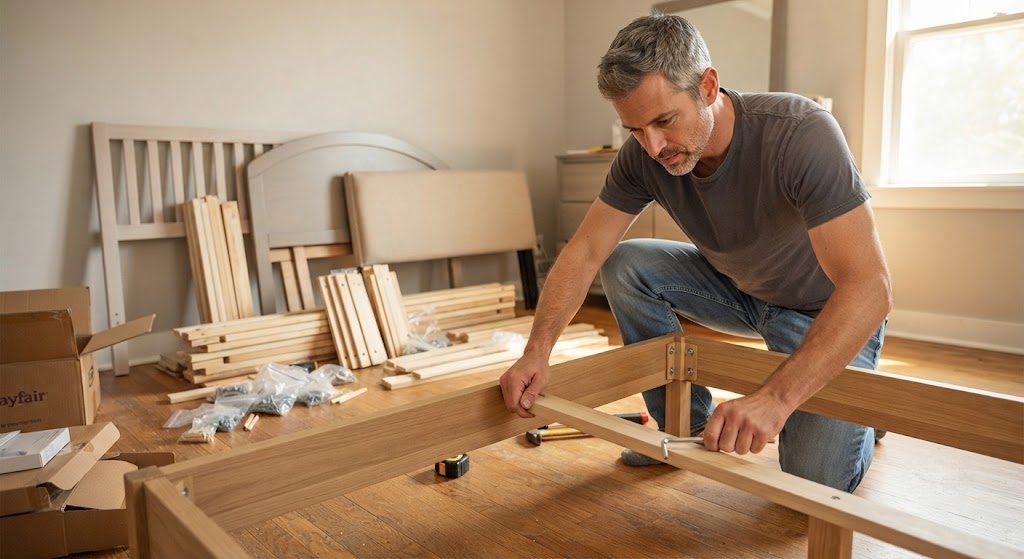
I assembled each frame myself with only the provided tools, noting every stripped screw, misdrilled hole, and moment of pure frustration. Assembly quality alone eliminated three frames before the load tests began. The survivors faced the squeak test: 200 pounds of static weight shifting side-to-side and getting in and out twenty times in a row—any pop, creak, or tick was recorded. Finally, the sag test: I loaded the center of each frame with 400 pounds of distributed weight, using sandbags, and checked for any deflection in the support beam or slats after one hour. No mattress. No mercy.
The $200–$400 Tier: One Surprise, Two Disasters
The cheapest frame in the group—a $229 steel platform with a folding mechanism—was the easiest to assemble, requiring only twelve bolts and no separate center support. It passed the squeak test with zero noise. The welded steel grid eliminated the slat-to-frame contact that causes most creaks. It won't win any design awards, but for a guest room or rental, it's the pick.
Two other frames in this range failed before I even sat on them. A wood-veneer platform from a big-box retailer arrived with a split side rail and hardware packed in a single unlabeled bag. The instructions showed a different model. Another, a low-profile metal frame with plastic leg caps, shifted an inch during the first sit and never recovered. Price isn't the problem. Engineering neglect is.
The $400–$800 Sweet Spot: Two Winners, Different Materials
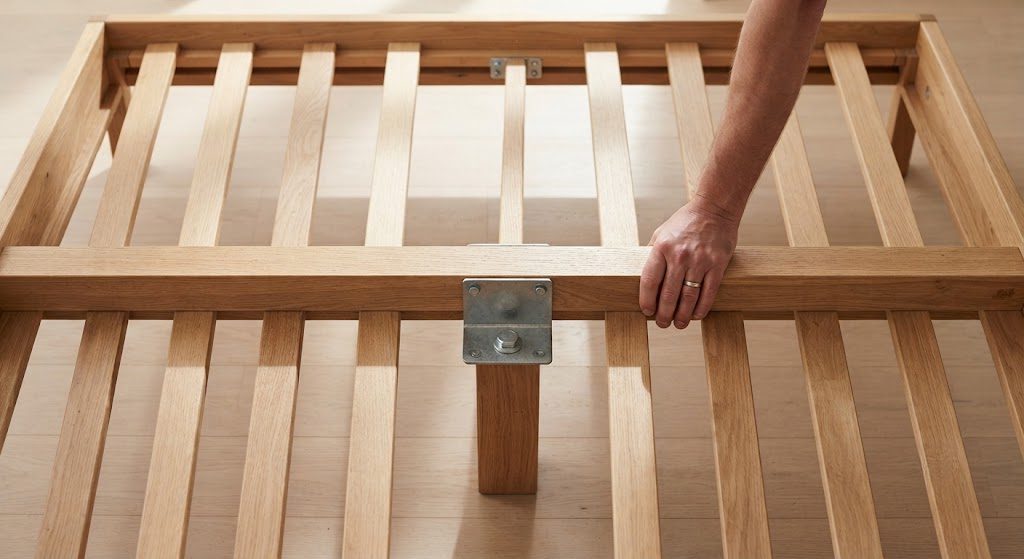
A solid pine frame with a slatted headboard, priced at $490, used five center support legs and a 1.5-inch thick hardwood beam. The slats were screwed down, not just laid loose. Assembly took forty minutes with a drill—not included, but the hex key was. It survived the weight test with less than a quarter-inch of deflection, better than frames costing twice as much.
The other winner here was an upholstered platform at $680 with a bent plywood slat system and a reinforced steel center rail. The headboard attached with four metal brackets that locked solid—no wall bumping. Fabric was a 45,000 double-rub polyester in charcoal. Assembly was complex but logical: two people, seventy minutes, no re-dos.
$800–$1,500: One Frame That's Worth It, One That Isn't
A $1,250 solid acacia frame from a direct-to-consumer brand used bed bolts with threaded inserts—the same joinery found in heirloom furniture. The headboard alone weighed forty pounds. Assembly took ninety minutes but the result was dead silent and rock solid. That frame will survive a move, a marriage, and maybe a teenager. It earns its price through hardware quality alone.
The $1,450 frame that failed? A metal-and-wood hybrid with a roll-slatted base that sounded like a drum kit during the squeak test. The metal slat holders were attached with thin-gauge screws that stripped on installation. Beautiful design, terrible execution. Skip it.
Price | Material | Center Legs | Assembly Time | Passed? |
|---|---|---|---|---|
$229 | Steel | Integrated | 20 min | Yes |
$490 | Solid Pine | 5 | 40 min | Yes |
$680 | Upholstered/Plywood | 3 (steel rail) | 70 min | Yes |
$1,250 | Solid Acacia | 4 | 90 min | Yes |
What I'd Buy Right Now
For under $500, the solid pine frame is a genuine find—silent, sturdy, and built with joinery logic that belongs at $800. For a primary bedroom I'd go straight to the $1,250 acacia. You feel the difference the first time you roll over and hear nothing but your own breathing. Avoid frames with unlabeled hardware, loose slats, or fewer than three center legs on a queen or larger. And if the assembly instructions look like they were designed in 2003, trust that instinct.
Keep Reading
How to Choose the Best Mattress for Heavy People
Find the best mattress for heavy people with practical guidance on support, dura...

How to Choose the Best Standing Desk for Your Home Office
Find the best standing desk for your room, budget, and work habits. Compare stab...
How to Choose the Best Mattress for Side Sleepers
Find the best mattress for side sleepers with practical picks, material advice, ...
Owner Letters
0 lettersNo letters yet — be the first to write one.