
"Solid Wood" Doesn't Mean What You Think It Means
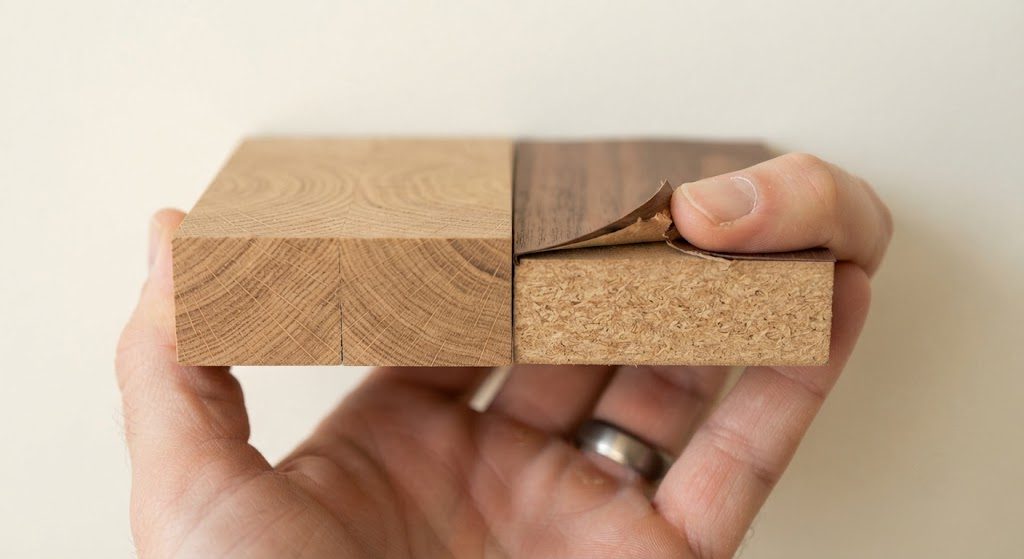
I've read thousands of furniture spec sheets, and the gap between what "solid wood" sounds like and what it actually means is where most shoppers get misled. Walk into any furniture store and you'll see the term on hangtags at every price point, from a $299 side table to a $4,000 dining table. But solid wood isn't one thing. It's a category with at least four distinct meanings—and only one of them means what you probably think it does.
The Four Definitions of "Solid Wood"
When a furniture tag says "solid wood," it can mean any of the following. The difference determines how the piece will age, how it handles humidity, and whether it's repairable.
Solid Lumber
This is the real thing. A single piece of wood, cut from a tree, kiln-dried to 6–8% moisture content, and machined into a component—a table leg, a chair stile, a bed rail. Solid lumber moves. It expands and contracts with seasonal humidity changes, which is why well-made tables use breadboard ends or frame-and-panel construction to accommodate that movement. When solid lumber cracks, it can be glued and clamped back together. When solid lumber scratches, you can sand it down and refinish it. This is what you want for structural parts: legs, frames, rails.
Solid Wood (Glued-Up)
This is still real wood—just smaller pieces joined together. Think a tabletop made of 3-inch-wide oak boards edge-glued into a panel. It's stable, strong, and entirely legitimate. The glue joints, when done properly, are stronger than the wood itself. Most dining tables in the $800–$2,500 range use this construction. It's marked "solid wood" and it's true—but it's not a single slab, and that's fine.
Engineered Wood (With a Solid Wood Face)
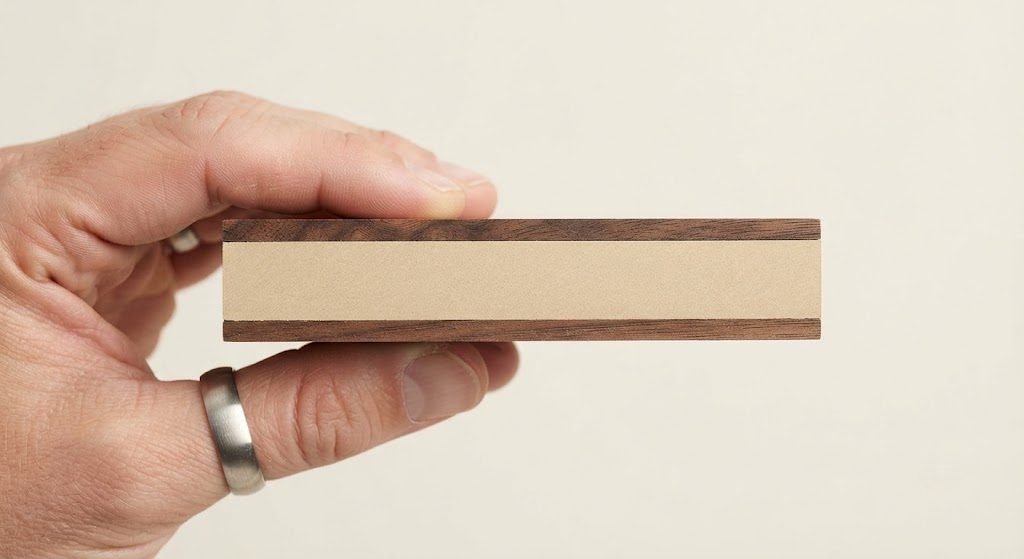
Here's where tags get creative. "Engineered wood" typically means plywood with a real wood veneer on the visible surface. Plywood is layers of wood grain rotated 90 degrees with each layer, glued under pressure. It's incredibly stable—more dimensionally stable than solid lumber, actually—and for cabinet cases, shelving, and drawer boxes, it's often the superior material. The problem isn't the plywood. The problem is when salespeople call it "solid wood" because the face veneer is real wood. It's not solid wood. It's engineered. And in the right application, that's a feature, not a flaw.
Medium-Density Fiberboard (MDF)
MDF is wood fiber mixed with resin and compressed into panels. It's heavy, uniform, and entirely immune to warping. It's also impossible to repair once damaged, and it doesn't hold screws well in repeated use. MDF with a wood veneer is common in bookshelves and entertainment centers under $600. It's often labeled "wood construction" or "solid wood product"—phrases that sidestep the truth without technically lying. If the tag says "solid wood product," you're almost certainly looking at MDF or particleboard with a veneer.
When Engineered Wood Is the Smarter Choice
After 15 years buying furniture, I'll say this clearly: solid wood isn't always the right answer. For a dining table that will see daily use, spills, and decades of holidays, solid lumber or glued-up solid wood is worth the investment. But for a bookshelf that sits against a wall and holds weight, plywood with a thick veneer will stay flat and stable while a solid wood shelf might cup or twist over time.
The best furniture manufacturers use both materials intentionally—solid wood where it shows and takes stress, engineered wood where stability matters. The dishonesty isn't in using engineered wood. It's in calling it something it isn't.
The One Phrase That's Almost Always Misleading
"Solid wood product." If you see that phrase on a tag, assume MDF or particleboard until proven otherwise. The word "product" does all the heavy lifting—it means the item contains some wood, in some form, and the manufacturer's legal team is comfortable with the language. Real solid wood is labeled as a species: oak, maple, birch, walnut, acacia. If the tag won't name the tree, that's your signal.
Ask one question: "What species is the solid wood?" If they can't answer, it's not solid wood. Move on.
Keep Reading
The Five-Second Drawer Test That Tells You Everything About a Dresser
I've opened thousands of drawers as a furniture buyer, and five seconds is all I...
Fabric Rub Count, Foam Density, and Frame Joinery: A Buyer's Translation Guide
Three numbers determine how long a sofa lasts, and most shoppers never see them....
Leather Grades Are Half Marketing. Here's What the Buyer's Spec Sheet Actually Cares About.
Full grain, top grain, bonded, corrected—the leather grades you see on retail ta...
Owner Letters
0 lettersNo letters yet — be the first to write one.