
The Five-Second Drawer Test That Tells You Everything About a Dresser
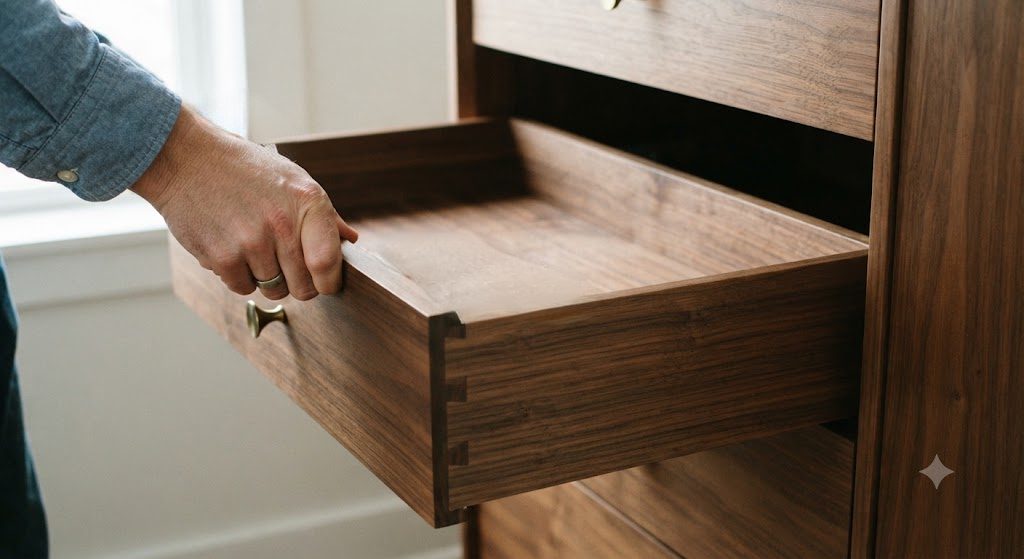
The drawer is the most honest part of any case piece. Tables can hide bad joinery under a tabletop. Bed frames can mask weak engineering behind a headboard. But a drawer—a drawer gets touched every single day. It gets pulled, pushed, overloaded, and slammed by people in a hurry. A well-built drawer reveals itself immediately. So does a cheap one. I've opened enough drawers in enough showrooms and factories that I can assess one in five seconds flat. Here's exactly what I check, in order.
The Five-Second Sequence
This isn't a casual glance. It's a fast, repeatable inspection that catches 90% of quality problems before you ever check the price tag. I start at the front and work backward.
Second One: The Joinery
Pull the drawer open about six inches and look at the front corner where the drawer side meets the drawer face. You want to see interlocking dovetail joints—the kind that look like puzzle pieces. Through dovetails, where the wood fingers are visible from the outside, are the gold standard. Half-blind dovetails, visible only from the side, are perfectly acceptable. If you see vertical lines of dowels, that's mid-tier. If you see staples, a single dado groove with glue, or butt joints with a nail gun, close the drawer and walk away. That drawer is assembled with speed, not longevity, and it will loosen within two years of daily use.
Second Two: The Drawer Bottom
This is the test that separates the genuinely well-built from the convincingly styled. Press your palm flat against the center of the drawer bottom. A solid bottom panel made of real wood—typically cedar or plywood with a wood veneer—should deflect no more than an eighth of an inch under firm pressure. Now look at the edges. The bottom panel should be set into grooves cut into all four sides of the drawer box, not stapled or nailed to the underside. A grooved-in bottom panel can be replaced if it ever cracks. A stapled one cannot. And if the bottom panel is a thin sheet of hardboard with a printed wood grain, expect it to sag under the weight of a sweater collection within three years. Drawer bottoms fail more quietly than any other component, and they fail more often than you'd believe.
Second Three: The Slides
Push the drawer in and pull it out smoothly. High-quality drawers use full-extension ball-bearing slides rated for 75 to 100 pounds. These let you access the entire drawer, all the way to the back. Undermount slides are even better—they're invisible, soft-close, and typical on pieces above $1,200. If the drawer uses side-mount slides and stops opening four inches short of the back, it's a cost-cutting move. If it uses wood-on-wood slides with a center guide, that's traditional joinery and perfectly fine—but only if the wood is waxed smooth and the drawer doesn't rack side-to-side when pulled. Rock the drawer gently left and right. Any more than a quarter-inch of play means the slides are undersized or misaligned.
Seconds Four and Five: The Finish Inside
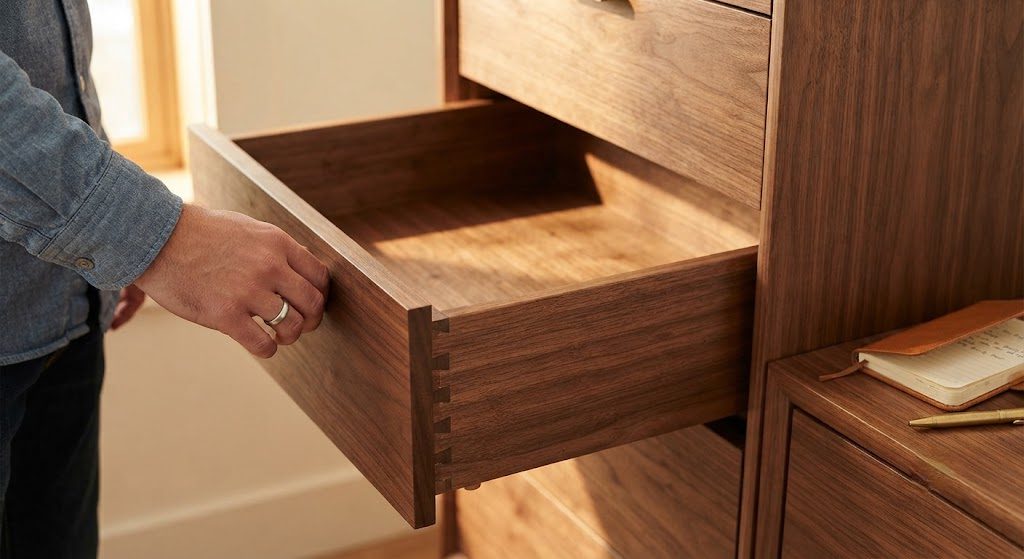
Most people never touch the inside of a drawer during a showroom visit. That's a mistake. Run your fingers along the interior corners and the underside of the drawer bottom. A quality piece will have sanded, smooth surfaces—maybe not finished, but certainly not rough. A rough interior means the manufacturer cut costs where they thought nobody would look. It's also where splinters live. If the inside of the drawer feels unfinished, the outside probably has shortcuts you haven't found yet.
What All This Tells You
A dresser is just a box with drawers. The face frame, the finish, the hardware—those are what you see. The drawer joinery, the bottom panel thickness, and the slide hardware are what you live with. I've seen $600 dressers with dovetailed drawers and solid bottoms that outperform $1,800 dressers with stapled joints and veneered MDF. Price doesn't guarantee quality. The five-second drawer test does.
Next time you're in a store, ignore the styling. Pull the top drawer open. Press the bottom. Rock it gently. Check the corners. Five seconds, and you'll know exactly what you're buying.
Keep Reading
"Solid Wood" Doesn't Mean What You Think It Means
Solid wood. Engineered wood. Veneer. MDF. These terms get thrown around like the...
Fabric Rub Count, Foam Density, and Frame Joinery: A Buyer's Translation Guide
Three numbers determine how long a sofa lasts, and most shoppers never see them....
Leather Grades Are Half Marketing. Here's What the Buyer's Spec Sheet Actually Cares About.
Full grain, top grain, bonded, corrected—the leather grades you see on retail ta...
Owner Letters
0 lettersNo letters yet — be the first to write one.